Reactive clay soils in Sydney: why houses move and how to keep them still
Clay is the most common reason a solid, well-built Sydney house develops cracks twenty years after it was finished. The house has not failed; the ground under one side of it has changed. Most of that change is caused by water, and most of the water is within the owner's control.
Footing & Frame editors · Published 24 Nov 2026 · Last reviewed 24 Nov 2026
At a glance
- Reactive clay swells when it takes up water and shrinks when it dries. The house rises and falls with it.
- Movement only causes damage when it is uneven: one corner wetter or drier than the rest of the footing.
- Leaking pipes, downpipes that empty beside the walls, over-watered garden beds and thirsty trees are the usual causes.
- Sites are classed from A (stable) to E (extremely reactive), with P for problem sites. The class sets how footings must be designed.
- Fix the water first, watch the cracks, and bring in an engineer before anyone proposes underpinning.
What reactive clay is
Clay soils hold water between their very fine particles. As the clay takes up water it swells, and as it dries it shrinks. The CSIRO's homeowner guide to foundation maintenance and footing performance describes this seasonal swelling and shrinking as one of the main ways clay foundations move, and it is why the same house can sit slightly higher at the end of a wet winter than at the end of a dry summer.
Movement on its own is not a problem. Footings on clay sites are designed to cope with it. Damage happens when the movement is uneven, so that one part of the footing rises or settles more than the rest. Brickwork and plaster cannot follow that kind of distortion, so they crack.
Clay is common across the Sydney region, and its reactivity can change over short distances. Geotechnical research on reactive soils in Western Sydney, for example, set out to measure how much reactivity varies across a single residential block. That variation is one reason a soil test is done for each site rather than assumed from the suburb.
Site classes, from A to P
Before a house is built, the soil is tested and the site is given a class under the Australian standard for residential slabs and footings, AS 2870. The CSIRO guide sets out the classes:
- Class A: most sand and rock sites, with little or no ground movement from moisture changes.
- Class S: slightly reactive clay sites, with only slight ground movement.
- Class M: moderately reactive clay or silt sites.
- Class H1 and H2: highly reactive clay sites, with high (H1) or very high (H2) ground movement.
- Class E: extremely reactive sites, with extreme ground movement.
The classes are based on the surface movement expected from moisture changes, which runs from under 20 mm on a class S site to more than 75 mm on a class E site. Sites with uncontrolled fill, soft soils, or trees that will affect the footings are classed P, for problem site, and need footings designed by an engineer.
If you own a house built in the last few decades, the site class is usually written on the engineering drawings or in the soil report lodged with the building approval. Knowing the class tells you how sensitive the house is to the habits described below.
What makes clay move unevenly
The CSIRO guide is blunt about the causes. Almost all of them are water in the wrong place:
- Leaking pipes. A water service, sewer or stormwater pipe near the house can saturate the clay under a footing. The guide notes that even a minuscule leak can be enough, and that a leaking tap near the building has the same effect.
- Pipe trenches. Backfilled trenches can act as watercourses, carrying water along the line of the footings and into the subfloor.
- Roof water. Blocked or badly graded gutters overflow, corroded downpipes spill, and downpipes not connected to the stormwater system concentrate roof water on the soil right beside the footings.
- Gardens and watering. The guide describes watering of garden plants, shrubs and trees as causing some of the most serious water problems, and over-watering by automatic irrigation as a common cause of saturation under footings.
- Trees. Roots near the footings draw moisture out of the clay, causing shrinkage and settlement on that side of the house. Roots can also lift footings directly.
- Excavation. Digging close to a footing, inside what engineers call the angle of repose, removes the soil that supports it.
Signs the ground is moving
Look for patterns rather than single cracks:
- stepped cracks following the mortar joints in brickwork, especially near corners and over doors and windows;
- cracks that open in one season and close in another;
- doors and windows that stick in one season and not the other;
- gaps opening between the skirting boards and the floor, or between cornices and the ceiling;
- a timber floor that has become bouncy in one area, which the CSIRO guide links to loss of support under the floor.
The standard's damage classification, reproduced in the CSIRO guide, gives a sense of scale. Fine cracks under 1 mm do not need repair. Cracks under 5 mm, with doors and windows sticking slightly, count as slight damage that can be filled. From 5 to 15 mm, or several cracks of 3 mm or more in one group, the damage is moderate and part of the wall may need replacing. Our guide to cracks in walls explains how to measure and record them.
Keeping the clay at an even moisture
The aim is simple: keep the soil around the whole house at a steady moisture content, all year. The CSIRO guide's recommendations translate into a practical list:
- Repair leaks straight away. The guide also suggests moving taps away from the house where possible, so any leak does not direct water to the footings.
- Connect every downpipe to the stormwater system, and keep gutters clear and correctly graded. Our guide to stormwater and drainage around Sydney homes covers how the system should work.
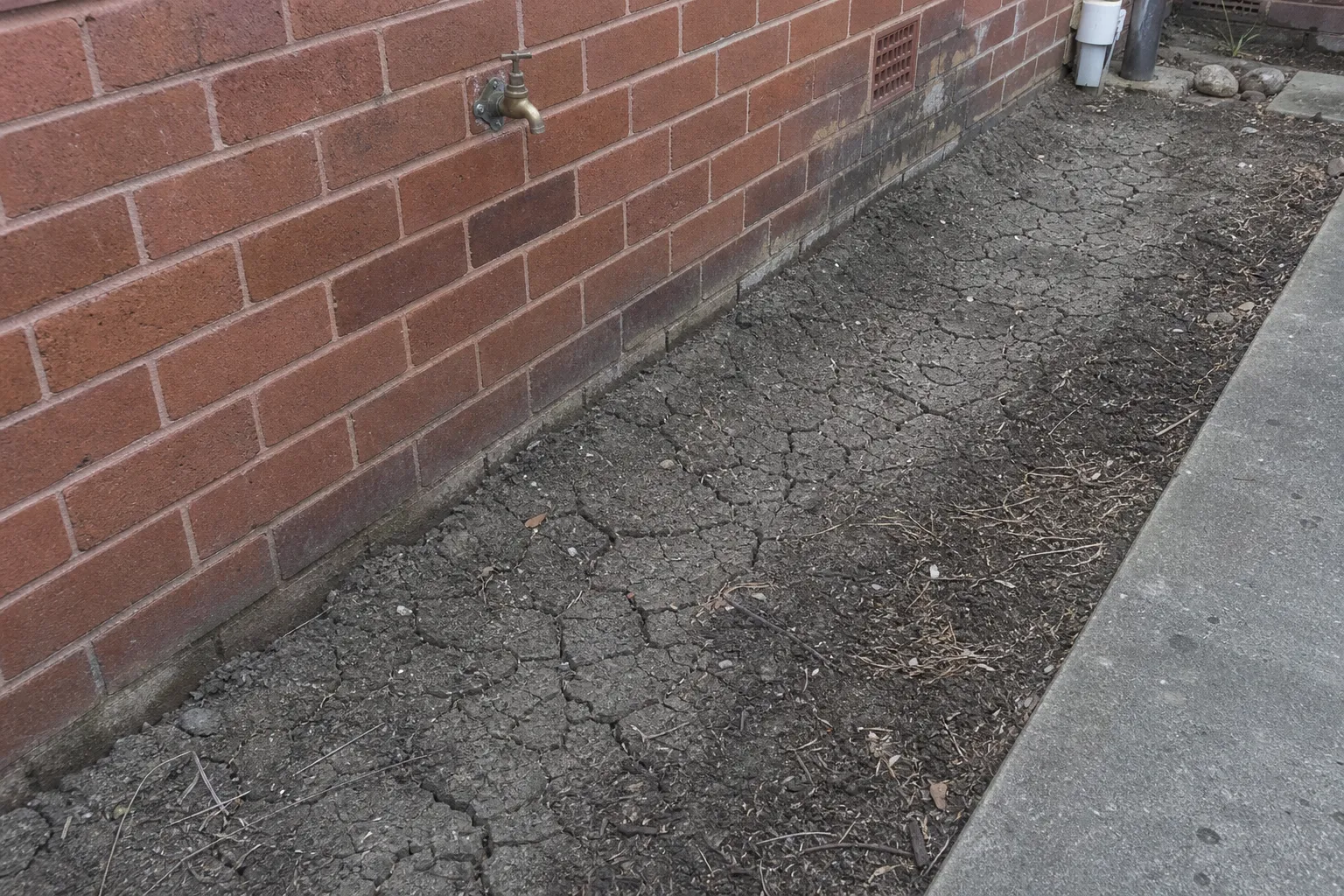
- Pave a strip around the house. Where problems exist or are likely, the guide recommends a paved apron at least 900 mm wide, more on highly reactive soil, falling away from the house at no less than 1 in 60, and finishing at least 100 mm below the bases of the brick vents.
- Move thirsty planting outwards. Keep lawn or plants that need only light watering closest to the house, with more demanding plants, shrubs and then trees further out. Keep automatic irrigation well away from the walls.
- Deal with surface water. If water flows towards the house in heavy rain, a grated drain connected to the stormwater system is usually an easy solution, according to the guide.
Plumbing and drainage work in NSW, including connecting downpipes and repairing sewer and stormwater pipes, must be done by a licensed plumber or drainer. You can check a licence on the Service NSW register before work starts.
Trees on clay sites
A large tree close to a house on reactive clay can dry the soil under one side of the footings. The CSIRO guide suggests that where the offending roots are minor ones and cutting them will not seriously harm the tree, they can be severed and a vertical concrete or metal barrier placed in the soil to stop them growing back towards the house. Where the tree is drying the soil more broadly, it recommends professional advice before removing or relocating the tree.
Removal is not always the answer, and it is not always allowed. NSW Planning advises that you generally need permission from your local council to clear trees and vegetation, even on your own property. An arborist and an engineer together can tell you whether the tree or its removal is the greater risk.
When to call a structural engineer
Bring in an engineer if cracks are wider than about 5 mm, are clearly growing between measurements, run diagonally through walls, or come with sloping floors, distorted door frames or leaning walls. Do the same before buying a house that shows these signs, and before any excavation near the footings.
A good engineer will look for the water source first. The CSIRO guide is clear that where movement is caused by water service, roof plumbing, sewer or stormwater failure, the remedy is to repair the problem. Underpinning is a major, expensive repair that should follow an investigation, not replace it. Our guide to hiring a structural engineer covers registration and what to ask.
Questions people ask
How do I find out my site class?
Look in the soil report or the engineering drawings from the original building approval. If you cannot find them, a geotechnical engineer can test the soil and classify the site.
Is a class H or E site a reason not to buy?
Not on its own. Houses on highly reactive sites perform well when the footings were designed for the class and water around the house is managed. Check the condition of the walls and floors, and get a building inspection, before you buy.
Can I remove a tree that is cracking my house?
Check with your council first, because in NSW you generally need permission to remove trees, even on your own land. Get advice from an arborist and an engineer before deciding.
Do cracks from clay movement close up again?
Seasonal cracks often open and close with the weather. Cracks that keep growing year after year point to a continuing cause, usually water, and need investigation.
Is a paved path around the house really worth it?
On reactive clay it helps keep the soil next to the footings at an even moisture. It has to fall away from the house and sit below the brick vents, or it can make things worse.
References
- CSIRO: Foundation Maintenance and Footing Performance, a homeowner's guide (PDF)
- ISSMGE conference paper: Small scale variability of reactive soils in Western Sydney (PDF)
- NSW Planning: Protecting our urban trees and vegetation
- NSW Government: Plumbing, draining and gasfitting work
- Service NSW: Verify a licence
- NSW Government: Professional engineer registration
This article is general information for New South Wales. It is not engineering, legal or building advice for your property. Rules change: check the linked official sources and use qualified, licensed people.